






- Whereas deploying Precision Time Protocol (PTP) at Meta, we’ve developed a simplified model of the protocol (Easy Precision Time Protocol – SPTP), that may provide the identical stage of clock synchronization as unicast PTPv2 extra reliably and with fewer assets.
- In our personal exams, SPTP boasts comparable efficiency to PTP, however with important enhancements in CPU, reminiscence, and community utilization.
- We’ve made the supply code for the SPTP consumer and server out there on GitHub.
We’ve beforehand spoken in nice element about how Precision Time Protocol is being deployed at Meta, together with the protocol itself and Meta’s precision time structure.
As we deployed PTP into one in all our knowledge facilities, we have been additionally evaluating and testing various PTP purchasers. In doing so, we quickly realized that we may eradicate numerous complexity within the PTP protocol itself that we skilled throughout knowledge middle deployments whereas nonetheless sustaining full {hardware} compatibility with our current tools.
That is how the thought of Easy Precision Time Protocol (SPTP) was born.
However earlier than we dive underneath the hood of SPTP we must always discover why the IEEE 1588 G8265.1 and G8275.2 unicast profiles (right here, we simply name them PTP) weren’t an ideal match for our knowledge middle deployment.
PTP and its limitations
Extreme community communication
A typical IEEE 1588-2019 two-step PTPv2 unicast UDP circulate consists of the next trade:
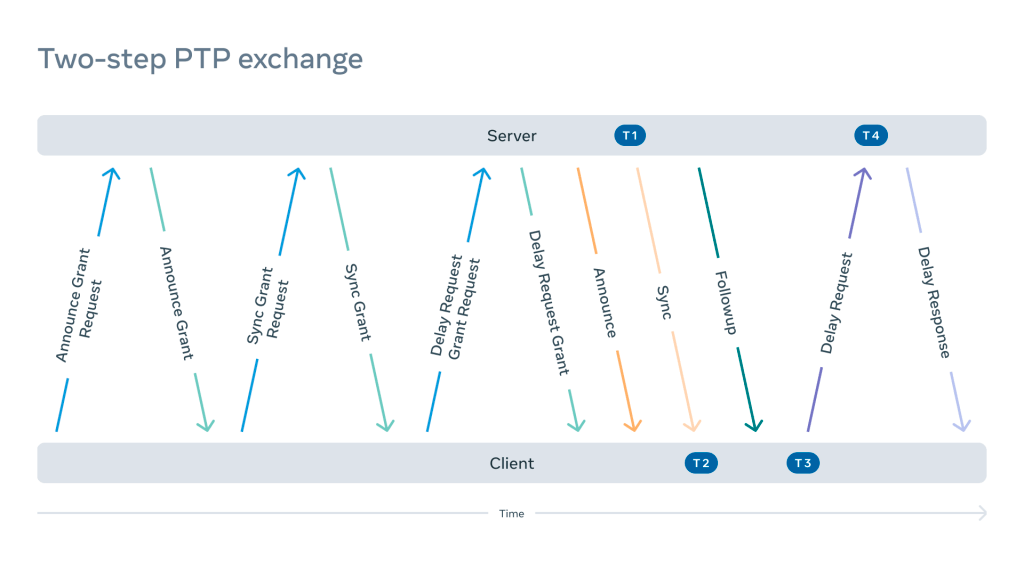
This sequence repeats both in full or partly relying on the negotiation end result. The trade proven is one in all many potential mixtures. It could contain further steps resembling grant cancellation, grant cancellation acknowledgements, and so forth.
The frequency of those messages could fluctuate relying on the implementation and configuration. After finishing negotiation, the frequency of some messages can change dynamically.
This design permits for lots of flexibility, particularly for much less highly effective tools the place assets are restricted. Together with multicast, it permits us to assist a comparatively massive variety of purchasers utilizing both very previous or embedded gadgets. For instance, a PTP server can reject the request or verify a much less frequent trade if the assets are exhausted.
This design, nevertheless, results in extreme community communication, which is especially seen on a time equipment serving numerous purchasers.
State machine
Because of the “subscription” mannequin, each the PTP consumer and the server must preserve the state in reminiscence. This strategy comes with the tradeoffs resembling:
- Extreme utilization of assets resembling reminiscence and CPU.
- Strict capability limits that imply multicast assist is required for big numbers of purchasers.
- Code complexity.
- Fragile state transitions.
These points can manifest, for instance, in so-called deserted syncs – conditions the place the work of a PTP consumer is interrupted (both forcefully stopped or crashed). As a result of the PTP server didn’t obtain a cancellation signaling message it’ll preserve sending sync and followup packets till the subscription expires (which can take hours). This results in further complexity and fragility within the system.
There are further protocol design unwanted side effects resembling:
- An virtually infinite Denial of Service Assault (DoS) amplification issue.
- Server-driven communication with little management by the consumer.
- Full belief within the validity of server timestamps.
- Asynchronous path delay calculations.
In knowledge facilities, the place communication is usually pushed by a whole bunch of 1000’s of purchasers and multicast shouldn’t be supported, these tradeoffs are very limiting.
SPTP
True to its identify, SPTP considerably reduces the variety of exchanges between a server and consumer, permitting for way more environment friendly community communication.
Change
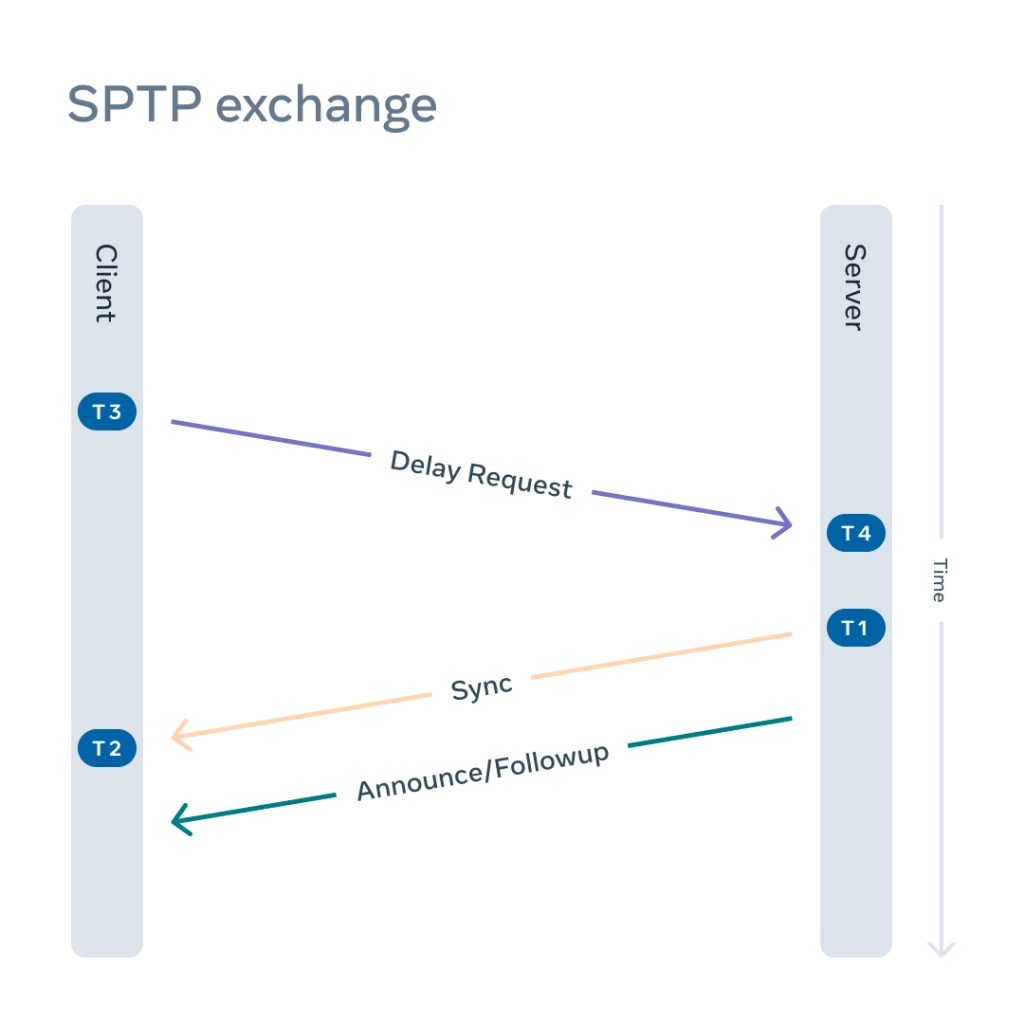
In a typical SPTP trade:
- The consumer sends a delay request.
- The server responds with a sync.
- The server sends a followup/announce.
The variety of community exchanges is drastically diminished. As a substitute of 11 completely different community exchanges as proven on Determine 1 and the requirement for consumer and server state machines all through the subscription, there are solely three packets exchanged and no state must be preserved on both facet. Within the simplified trade, each packet has an necessary function:
Delay request
A delay request initiates the SPTP trade. It’s interpreted by a server not solely as a normal delay request containing the correction area (CF1) of the clear clock, but in addition as a sign to reply with sync and followup packets. Identical to in a two-step PTPv2 trade, it generates T3 upon departure from the consumer facet and T4 upon arrival on the server facet.
To differentiate between a PTPv2 delay request and a SPTP delay request, the PTP profile Particular 1 flag should be set by the consumer.
Sync
In response to a delay request, a sync packet could be despatched containing the T4 generated at an earlier stage. Identical to in a daily two-step PTPv2 trade, a sync packet will generate a T1 upon departure from the server facet. Whereas in transit, the correction area of the packet (CF2) is populated by the community tools.
Followup/announce
Following the sync packet, an announce packet is straight away despatched containing T1 generated at a earlier stage. As well as, the correction filed from the Delay Request area is populated by the CF1 worth collected at an earlier stage.
The announce packet additionally accommodates typical PTPv2 data resembling clock class, clock accuracy, and so forth. On the consumer facet, the arrival of the packet generates the T2 timestamp.
After a profitable SPTP trade, default two-step PTPv2 formulation for imply path delay and clock offset should be utilized:
mean_path_delay = ((T4 – T3) + (T2-T1) – CF1 -CF2)/2
clock_offset = T2 – T1 – mean_path_delay
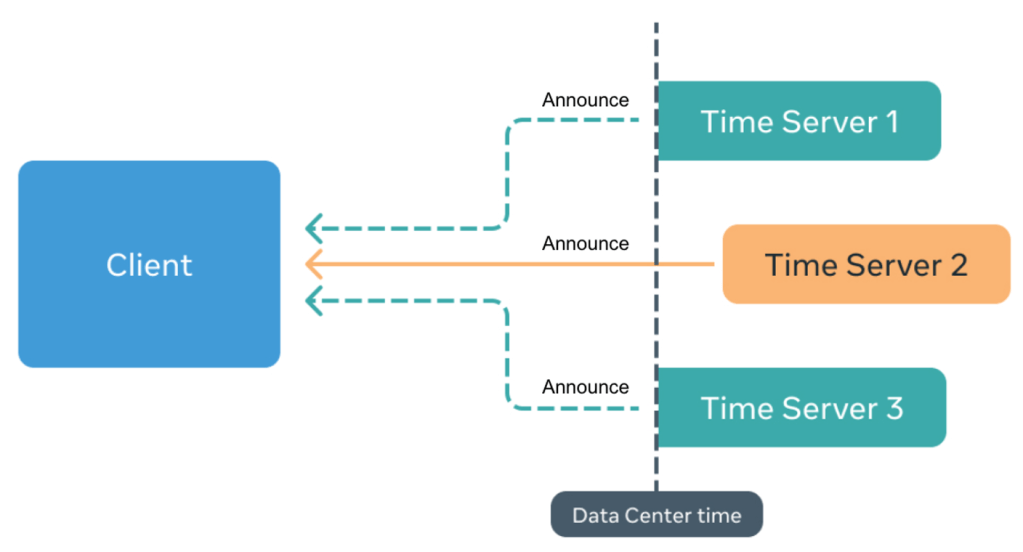
After each trade the consumer has entry to the announce message attributes resembling time supply, clock high quality, and so forth., in addition to the trail delay and a calculated clock offset after each trade with each server. And, as a result of the trade is client-driven, the offsets might be calculated at the very same time. This avoids a state of affairs the place a consumer is following a defective server and has no probability of detecting it.
Reliability
We will additionally present stronger reliability ensures by utilizing multi-clock reliance.
In our implementation for precision time synchronization, we offer time in addition to a window of uncertainty (WOU) to the buyer utility through the fbclock API. As we described in a earlier weblog submit on how PTP is being deployed at Meta the WOU relies on the commentary of time sync errors for the minimal period to have stationarity of the state of the system.
As well as, we’ve established a technique based mostly on a group of clocks that every consumer can entry for timing data that we name a clock ensemble. The clock ensemble operates in two modes, regular state and transient; the place regular state is throughout regular operation and transient is within the case of holdover.
Nonetheless, with a pool of N clocks, C, forming the clock ensemble, the query turns into which clocks to pick for figuring out robustness and correct timing data. Clocks that aren’t correct are rejected (C_reject) and, thus, our ensemble measurement falls to N = C_total – C_reject. We make use of two levels, one that’s based mostly on every particular person clock, and the second that acts on the gathering of legitimate clocks within the ensemble.
The primary stage observes the earlier measurements of every particular person clock, the place the primary standards is to reject outliers within the earlier states of the clock. As soon as this criterion threshold is exceeded, your entire clock is rejected from the legitimate clock ensemble pool. That is based mostly off Chauvenet’s criterion, the place the criterion is a chance band that’s centered on the imply of the clock outputs (assuming a traditional distribution throughout regular state). Primarily based on the stationarity exams, we use a pattern measurement of 400 earlier clock outputs and calculate a most allowable deviation.
For instance:
, the place
is the present clock output,
is the clock pattern imply, and
is the clock set normal deviation.
We discover the chance that the present clock output is in disagreement with the earlier 400 samples:
Primarily based on a window measurement of 400 earlier samples, the utmost allowed deviation is:
Now, the clock outputs are examined towards this worth. In the event that they exceed the they’re rejected, an alert is raised, and a threshold counter is incremented. As soon as the rejection threshold is reached for a person clock, this clock is fully rejected.
Now, we enter the second stage of verifying the clock ensemble composed of the legitimate clocks. The second stage kinds a weighted common of the non-rejected clocks within the legitimate clock ensemble, the place every clock within the ensemble is reported as its pattern measurement, imply, and variance. The typical of the clocks’ means is the weighted common, the place the weights are inversely proportional to the imply absolute deviations reported by every clock after making use of Chauvenet’s criterion.
Now we will report the imply and variance of the clock ensemble, guaranteeing the clocks contained therewith are legitimate and never offering inaccurate values. The arrogance interval is scaled with the variety of good clocks within the ensemble, the place the upper the variety of legitimate clocks out of the overall clocks gives larger reliability.
For a lot of hosts, we present that the distribution of clocks falls throughout the following heatmap:
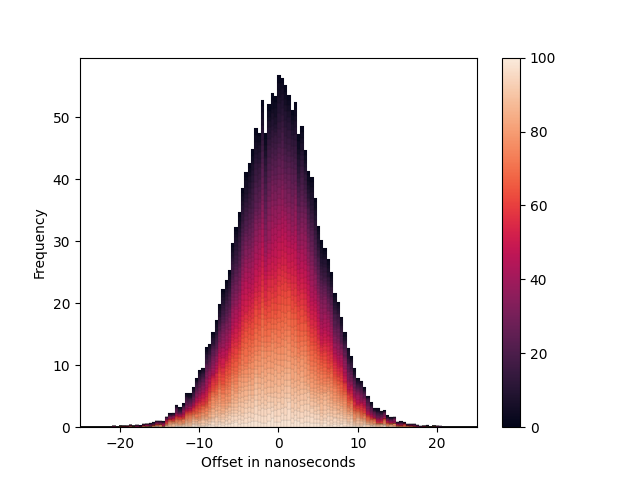
We calculate the variance, , of every particular person clock’s observations, then we calculate a weighted imply,
, considering the reciprocal of every clock’s variance as the load.
As a consequence of independence of clocks, the variance of the weighted sum, , is:
In abstract, we gather samples from a lot of clock sources that type our clock ensemble. The general precision and reliability of the supplied knowledge by SPTP is a perform of the variety of dependable and in distribution clocks forming the clock ensemble.
A future submit will deal with this particularly.
SPTP’s efficiency
Let’s discover efficiency of the SPTP versus PTP.
Preliminary deployments to a single consumer confirmed no regression within the precision of the synchronization:
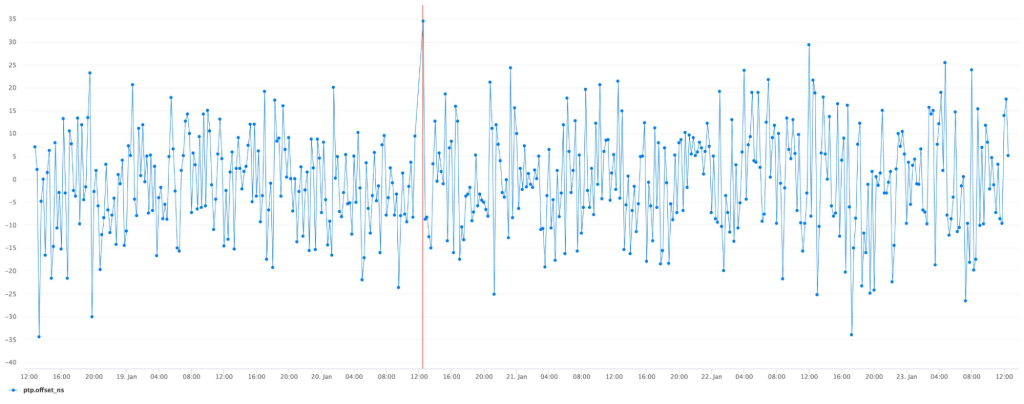
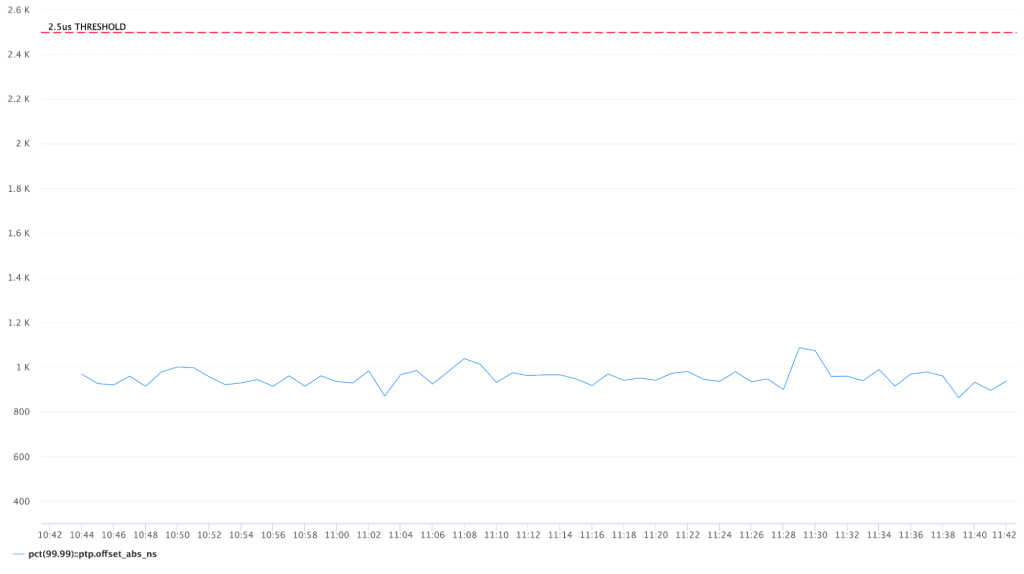
Repeating the identical measurement after migration to SPTP produces a really comparable end result, solely marginally completely different on account of a statistical error:
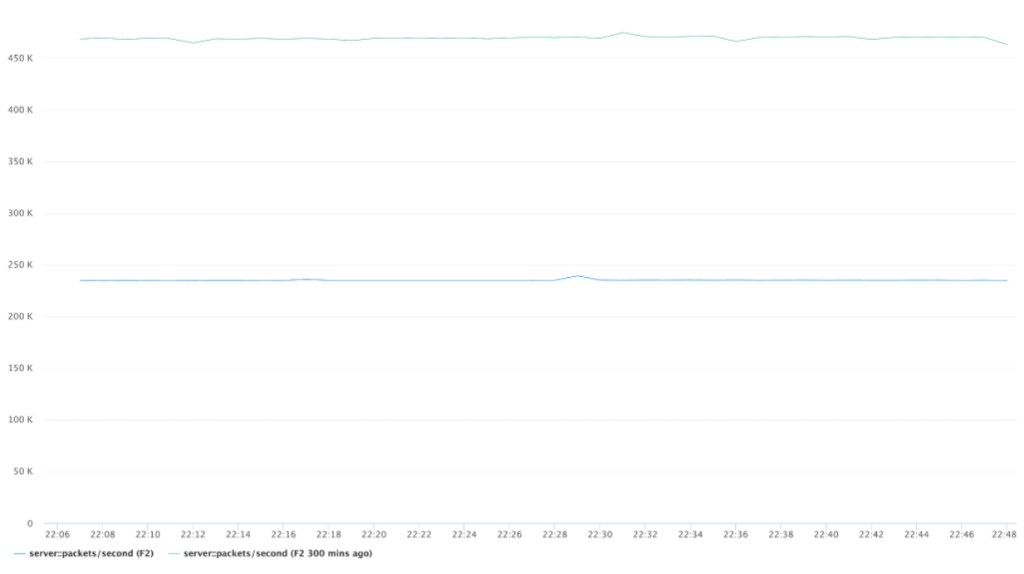
With large-scale deployment of our implementations, we will verify useful resource utilization enhancements.
We observed that because of the distinction in multi-server assist, the efficiency features fluctuate considerably relying on the variety of tracked time servers.
For instance, with only a single time equipment serving your entire community there are important enhancements throughout the board. Most notably over 40 p.c CPU, 70 p.c reminiscence, and 50 p.c community utilization enhancements:
The following steps for SPTP at Meta
Since SPTP can provide the very same stage of synchronization with so much fewer assets consumed, we predict it’s an inexpensive various to the prevailing unicast PTP profiles.
In a large-scale knowledge middle deployment, it could possibly assist to fight regularly altering community paths and create financial savings when it comes to community site visitors, reminiscence utilization, and variety of CPU cycles.
It’ll additionally eradicate numerous complexity inherited from multicast PTP profiles, which isn’t essentially helpful within the trusted networks of the trendy knowledge facilities.
It must be famous that SPTP is probably not appropriate for programs that also require subscription and authentication. However this might be solved by utilizing PTP TLVs (type-length-value).
Moreover, by eradicating the necessity for subscriptions, it’s potential to look at a number of clocks – which permits us to offer larger reliability by evaluating the time sync from a number of sources on the finish node.
SPTP can provide considerably easier, sooner, and extra dependable synchronization. Much like G.8265.1 and G.8275.2 it gives wonderful synchronization high quality utilizing a special set of parameters. Simplification comes with sure tradeoffs, resembling lacking signaling messages, that customers want to concentrate on and determine which profile is one of the best for them.
Having it standardized and assigned a unicast profile identifier will encourage wider assist, adoption, and popularization of PTP as a default exact time synchronization protocol.
The supply code for the SPTP consumer and the server might be accessed on our GitHub web page.
Acknowledgements
We wish to thank Alexander Bulimov, Vadim Fedorenko, and Mike Lambeta for his or her assist implementing the code and the maths for this text.







+ There are no comments
Add yours